Our Casuarina Tree

Toru Dutt (1856-1877), a 19th century Bengali woman writing exclusively in English and French, is best known as one of the first Indian women to respond intellectually and creatively to the literary and cultural ideologies of the West. The fact that she wrote at all, and that too in English, was due to the stirring processes of change that formed the central motive of 19th century Bengal. Western education through the medium of English, originally a political necessity for maintaining the Empire, soon became, for Indians, a tool to gain access to the ideas of modernity and progress that the post-Enlightenment West came to symbolise. For Toru Dutt, her family’s conversion to Christianity six years after her birth necessitated a further moving away from traditional orthodoxy, symbolised by Hinduism, into Westernised and, by association liberalised currents of thought. Toru’s deliberately anglicised upbringing and the efforts on the part of her father to educate his children in the literature and languages of Europe completed this process. At the time of her demise at the age of twenty-one, Toru had published a collection of French verse translated into English (A Sheaf Gleamed in French Fields) and had been working on a collection of English verse based on Sanskrit legends (Ancient Ballads and Legends of Hindustan). She was also working on a French novel and an unfinished draft of an English one- all of which was published after her death.

Anthologies on Indian writing in English categorise Toru Dutt as one of the ‘pioneers’ alongside Kasiprasad Ghose, Derozio and Michael Madhusudan Dutt. Over the years evaluations of Toru have been as diverse as her achievements. Edmund Gosse called her “This fragile exotic blossom of song” which established the standard critical response to her in the 19th and early 20th centuries as a literary curiosity.

Indian criticism was more uncomfortable. In a volume entitled Great Women of India, The Holy Mother Birth Centenary Memorial the editors concluded that “India hugs her to her bosom, no doubt, but finds nothing to show as hers, India’s”. More recent evaluations show Toru as a bridge between divided cultures, reconciling in art the spiritual exile of real life. Our Casuarina Tree – one of the seven poems on personal topics that ended the Ancient Ballads volume is one example of this complexity where she keeps her roles as Bengali/ India/ Christian/ exile in a fine balance.

The central symbol of the poem is the Casuarina tree. The poem follows a careful pattern of actual description (Stanzas 1 and 2) into an evocation of the tree as a symbol of childhood memories and associations (Stanzas 3 and 4). The first stanza describes the trunk of a giant tree encircled by a creeper of red flowers, providing day and night a haven for birds and bees. The second stanza continues the description and shows the tree at break of day, at noon and at twilight. In the third stanza there is a change in tone whence the tree metamorphoses into a symbolic link between the loneliness of the present and a joyous past. The sweet companions are Toru’s siblings no more – Abju who died in 1865 and Aru who died in 1874. The wind sighing through the casuarina tree blends with the melancholy murmur of waves breaking on the shore of the foreign lands Toru is now in. The picture dissolves into the poignant overtones of a traveller in foreign land, pining in a painful moment of nostalgia, for the comfortable familiarity of “one’s own loved native clime”.
One of the key features of this poem is of the sense of a writer caught between two worlds. Toru uses the English poetic model and its accompanying inheritance of stock metaphors, idioms and techniques. There is also the own world of the writer which was completely Indian. Hence the two worlds exist side by side-and the choice of the Casuarina tree, images like the python, kokilas, the grey baboon, the broad tank and the water lilies exist alongside highly stylized poetic language reminiscent of the great Romantics. The poem ends with a reference to a poem by Wordsworth, thereby acknowledging the world of the West and the literature of England as source and poetic inspiration.

Our Casuarina Tree exists as a poem of assimilation, one where English Romanticism is not just a flavour but where Indian and Western idioms coalesce in an organic whole. The technique is of the classic Romantic ode with its carefully crafted argument spread over five sections. The overall feel is of a deeply felt personal experience. There is a sense of loss, pain and suffering seen through the recurring image of the rolling seas. The joys of childhood are a contrast to the loneliness of the present. There is also the sense of a vast gulf, not only between the tree and her present surroundings but also between the two worlds that Toru lived in. Paradoxically she belonged to neither.

Writing at a time when Indian women were tentatively spreading their wings, Toru takes this self-fashioning a step further by producing a poem that relocated her western learning with her Indian identity. The poem is a testimony to the in -between characteristic of Toru’s own life – Indian yet Westernised, imitative yet still original, restless voyager yet yearning for her motherland, hemmed in by her contemporary constraints yet still breaking free of them. The poem shows an adaptibility that has ensured that it has survived and is significant today in a way that many other poems of her time are not.

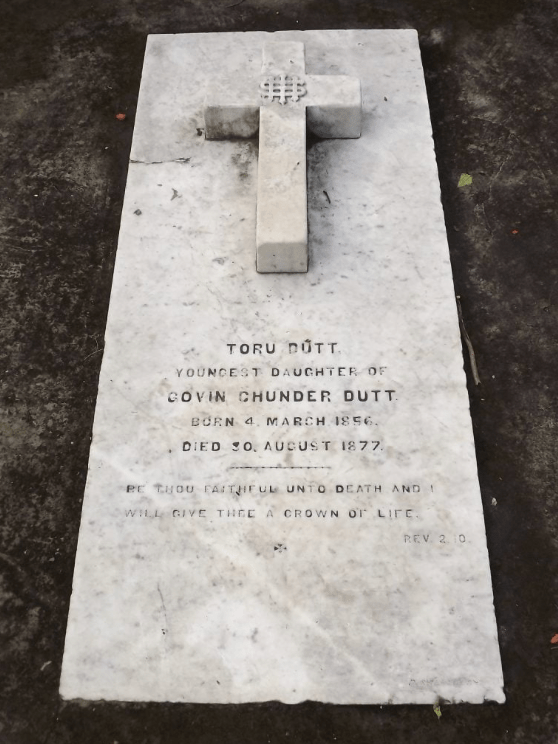
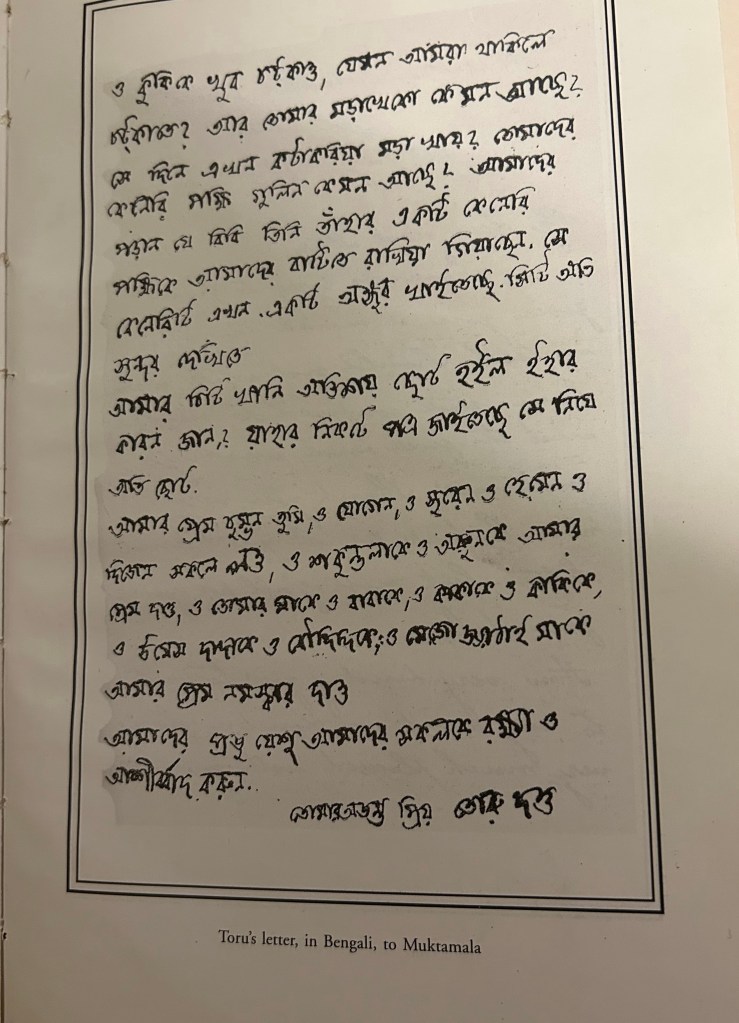
The only extant letter in Bengali by Toru Dutt, found in Harihar Das’ biography and reproduced above is written in a stilted halted language. The photograph of the Baugmaree garden house in what was then a suburb, where she spent her happiest days, free from the travails of the large joint family in the lanes of North Calcutta is also found in the same book. Toru’s grave lies near Maniktala Street, along with that of her family and has been preserved after many years of terrible neglect. Although she had hoped to return to England as a place of freedom and creativity, her illness prevented her from making the move. In her last letters written to her friend Mary Martin she had acknowledged her in-between status by melancholy acceptance- it was sad to leave her own land and begin a life elsewhere. Toru Dutt languished in school text books for many years before making her way in to the world of serious scholarship. This poem encapsulates all that she longed for, received and accepted.

May love defend her from oblivion’s curse.

An Autobiography of our Times

There is an anecdote describing how Nirad Chaudhuri celebrated his birthday in 1995 à la Jane Austen . Seized by yet another fancy, he decided to mark the day by a celebration which would re-enact a scene from Pride and Prejudice (where Darcy received his lady visitors and served them refreshments). Chaudhuri’s drawing room, decorated in a Victorian style was transformed into Regency England by the placement of a fruit bowl replete with apricots, nectarines, grapes. The guests were made to sit against the wall, ladies on one side, gentlemen on the other, provided with dainty fans with which they fanned themselves as Chaudhuri read the relevant passages from the novel. The celebration ended with jam tarts, game pie and champagne. Interestingly enough, Nirad Chaudhuri wore a dhoti and a panjabi while the invited ladies wore silk sarees—although what dress the other gentlemen wore is not detailed. (An Austen Afternoon, Shrabani Basu in Nirad C. Chaudhuri: The First Hundred Years: A Celebration ed. by Swapan Dasgupta).

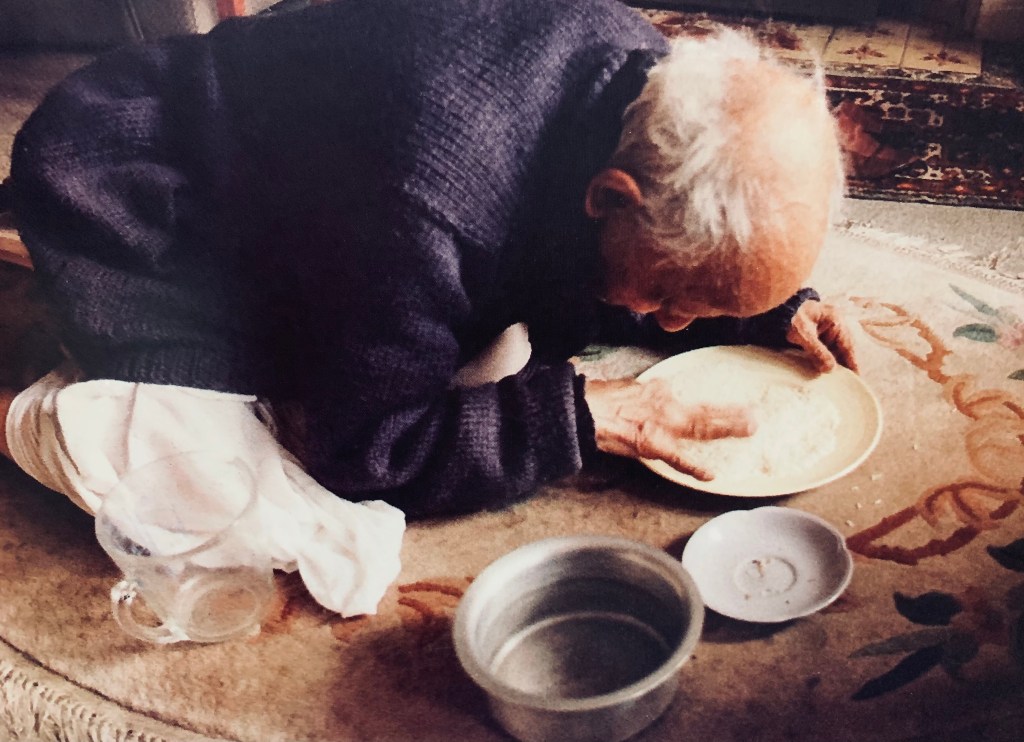
Shrabani Basu’s anecdote sums up the essence of Nirad Chaudhuri. Here was a man who exemplified a kind of universal humanism, one who saw nothing surprising in evoking the world of Jane Austen wearing dhoti-panjabi and saree. Photographs of him that are available in books and magazines show him both immaculately dressed in Western attire but also in dhoti. One of them is unique: Nirad Chaudhuri, sitting on the floor of his Oxford house, wearing a dhoti and short punjabi, bent over a plate of rice, separating shingle from grain in a room pretty in chintz and polished glass.

Image credit: Nirad C Chaudhuri, Many Shades, Many Frames – Dhruva N. Chaudhuri, New Delhi, 2011

Chaudhuri called himself “the last Englishman” and whether he was correct in his evaluation is a matter of debate, but it is certain that he was one of the last to embrace a cosmopolitanism that believed in the ideologies and cultural mores of the West, while at the same time being steeped in the sensibilities and mores of India. In this, Nirad Chaudhuri may be said to end what the Rambagan Dutts and Toru Dutt had begun—a perfect syncretic mixture of the Orient and the Occident that privileged England as the centre of the world but was moored towards one’s own tradition.

To read accounts of his boyhood years in Kishorganj, Banagram and Kalikutch is to move through a vanished world where time passed in the fruition of seasons, the coming of spring, summer, the monsoons and then winter, the cycle of Rathyatra, Charak and Durga Pujo, the world of vast gleaming rivers with fishing boats bobbing up and down like seeds, of skies sodden with dark grey rain clouds, of nights sharp with the fragrance of sewlee, champa and gandhoraj. Shut up in our box-like city apartments, Chaudhuri brings back the sense of village Bengal at the turn of the century in a style that is strikingly poetic in appeal. Bibhutibushan Bandopadhyay, the great Bengali writer who evoked this world as poignantly in his Bengali writings, was Chaudhuri’s mess-mate in Calcutta and one can only imagine the two figures lost in conversation about the world they had left behind.

But there in the mud huts of Kishorganj and Banagram, England touched the consciousness of the village world. Milton’s poetry and Shakespeare’s plays stood alongside volumes by Bankim Chandra Chatterji and Michael Madhusudhan Dutt on bookshelves while on the walls there were framed prints of Raphael, of Christ, of British victories in the Boer War. Young boys would come running home from play, whooping and shouting “England expects every man to do his duty” because they had read about the Battle of Trafalgar, and the sensation of river touching the sky in the horizon quickened read memories of this battle gleaned from school textbooks.

It would be incorrect to posit Chaudhuri as a denationalised Anglophile as he is often vilified. The anglicised Bengali had often real contributions to make and to find marks of a slavish adherence in the stream of lawyers, educators and government officials who lived and worked in an aggressive Westernised milieu would be to over simplify things. One finds resemblances with the Dutts before him, and others in the 19th and 20th centuries including Manmohan Ghosh (the more famous Aurobindo’s brother) and Michael Madhusudan Dutt, all of whom could be patriotic and concerned Indian citizens while still having an abstract identification with England. Five centuries ago this would be seen as part of the Liberal Humanist tradition. In the 20th century, however, this was seen as being denationalised.

For Chaudhuri, the problem was compounded by the fact that he attacked certain aspects of 20th century nationalism. That he had the courage to do so shows him as a man of conviction, and despite his childish, often whimsical exaggerations of English-ness he stood up to contemporary Gandhian and Nehruvian models. What he disliked was their reading of Indian history as being one of continuous marauding and exploitation by the structures of British imperialism and their refusal to acknowledge that post-Enlightenment Europe had certain important contributions to make on the Indian mind. To view the colonial state as being completely destructive and evil, with no positive contribution at all was something Chaudhuri was unable to accept.

In a remarkable passage in Chapter Four of The Autobiography of An Unknown Indian, Chaudhuri writes —

“The servility and malice ingrained in every fibre of our being which made us indulge in grotesque antics of alternative genuflexion and defiance before the Englishman persist to this day, and a most striking proof of this persistence was furnished by Mahatma Gandhi himself only one day before the announcement of the final British plan for transferring power to Indians, that is to say, on 2nd June 1947. After bestowing fulsome praise on Pandit Jawaharlal Nehru as the uncrowned kind of India and emphasizing with what appeared like a licking of lips that he was a ‘Harrow boy’, ‘Cambridge graduate’, and ‘barrister’, Mahatma Gandhi went on to declare that “our future presidents will not be required to know English.'”

For Nirad Chaudhuri “was savage in his dislike of the new class of Anglicised Indians who stepped into the shoes of the departing British in 1947” and “anticipated the moral fragility of the post-Independence order and its inability to take India forward.”(Introduction, Swapan Dasgupta in Nirad C. Chaudhuri: The First Hundred Years)

In Nirad Chandra Chaudhuri, I remember my grandfather. He was born in 1910 in Barishal, his father also a lawyer and many of the descriptions of provincial life supplied in Chapters One, Two and Three of The Autobiography remind me of my grandfather’s stories. Like Chaudhuri, my grandfather had faith in British systems, was an admirer of Matthew Arnold, described himself as having only one mistress who tempted him more than his wife and described this mistress as the glories of the English language and its literature. Was my grandfather de-nationalised? I think not. Immaculate in crisp dhotipunjabi and jahar coat, he would sit regally at the Calcutta Club, declaiming on Tallulah Bankhead and Tagore, all in the same breath.

Nirad Chaudhuri has found his way back into our lives via, unexpectedly, a newly-constituted English Literature university syllabus. At a time when the world is caught in a strange bind between provincial nationalism and a cosmopolitan non-exhibitionist internationalism, it is time to re-read The Autobiograpghy of an Unknown Indian. Chaudhuri teaches us that it is folly to swagger and swear in the latest Paris fashion, shallow and supercilious as we make our way unthinkingly through a globalised internet-fired post-pandemic world order, passing judgement on this and that, unthinkingly, unknowingly, sans reading, knowledge, judgement, understanding. It is time to embrace new worlds but to stay rooted in our own.